

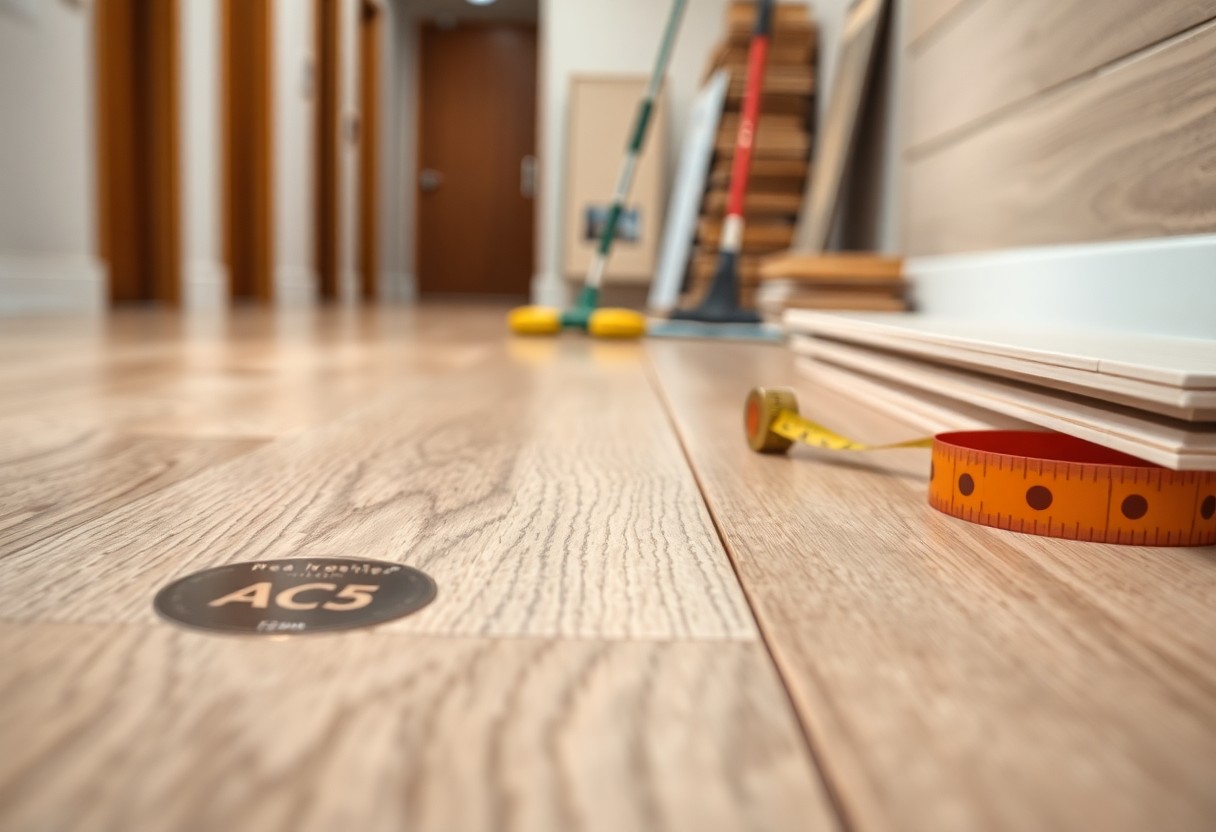
Just because laminate flooring looks good doesn’t mean it can handle constant foot traffic. You need a floor that withstands daily wear without showing scratches, dents, or fading. In high-traffic areas like hallways, kitchens, or retail spaces, your choice of laminate directly impacts longevity and appearance. You’ll assess durability through measurable features like AC ratings, core density, and protective layers. A mid-sized SaaS firm that converted its office common areas learned this the hard way when their sleek but low-rated laminate began chipping within months. Your decision should balance resilience, aesthetics, and installation readiness.
Understanding AC Ratings for Durability
Laminate flooring durability is measured by the Abrasion Class (AC) rating, a standardized scale developed by the European Laminate Flooring Association. This rating reflects a floor’s ability to withstand wear, impact, staining, and surface burning. Higher traffic areas demand higher AC values to maintain appearance over time. Manufacturers test each product rigorously to assign the appropriate class.
How to interpret the Abrasion Class scale
The AC scale ranges from AC1 to AC5, with each level indicating suitable applications based on foot traffic. AC1 suits low-traffic spaces like bedrooms, while AC2 handles moderate use in living rooms. AC3 is standard for most residential areas, including hallways. AC4 and AC5 are built for commercial or heavy residential use, such as retail stores or busy family homes.
Selecting the right rating for high-traffic zones
For areas like entryways, kitchens, or office lobbies, choose AC4 or AC5 rated laminate. These withstand constant foot traffic from shoes, furniture movement, and daily wear without significant surface degradation. A mid-sized SaaS firm that installed AC5 laminate in its open-plan office reported minimal scratching after two years of continuous use.
AC4 performs reliably in multi-occupant homes with pets and children, offering resistance to abrasion from daily activity. AC5 goes further, designed for environments where thousands of footsteps occur weekly. Look for manufacturer documentation confirming test compliance with EN 13329 standards, ensuring the rating is not self-assigned. Floors with AC5 ratings often include enhanced top layers and tighter board locking systems, contributing to long-term integrity in demanding settings.
Evaluating Core Density and Thickness Factors
Laminate flooring in high-traffic areas must withstand constant pressure and movement. Core density and board thickness directly influence how well the planks resist dents, warping, and separation over time. A denser core provides better impact resistance, while increased thickness contributes to stability underfoot. Knowing these factors helps you select a product built for longevity in busy environments.
Why board thickness matters for structural integrity
Thicker boards typically range from 10 to 12 millimeters and offer improved resistance to sagging between subfloor joints. They also reduce hollow sounds when walked on, especially over imperfect subfloors. Increased thickness supports better alignment under load, minimizing edge lifting in hallways or commercial spaces. This contributes to a more durable and quieter installation over time.
- Look for boards labeled 10mm or thicker for heavy-use areas
- Check manufacturer specifications for core material composition
- Prefer products with tight tongue-and-groove locking systems
- Avoid ultra-thin laminates (under 8mm) in commercial or high-traffic zones
Tips for identifying high-density fiberboard quality
Density affects how well the core resists moisture infiltration and surface damage. High-density fiberboard (HDF) feels heavier than medium-density alternatives and shows minimal swelling when exposed to brief moisture contact. Boards made with consistent, fine fibers tend to hold edges better under impact. This ensures long-term resilience in environments like retail stores or busy home entries.
- Inspect sample weight-denser boards feel noticeably heavier
- Ask for technical data sheets showing core density classification
- Perform a break test on a scrap piece to observe fiber consistency
- Choose brands that specify “HDF core” rather than generic “fiberboard”
Manufacturers that invest in precision compression during core production achieve tighter, more uniform boards. These resist chipping at the edges and maintain structural performance under repeated stress. This consistency is especially visible in cut edges and during installation alignment.
- Examine the edge of a cut plank for uniform texture without air pockets
- Compare cross-sections between budget and premium samples
- Look for low thickness-swelling ratings in product documentation
- Prefer flooring made in facilities with controlled humidity during production
Surface Texture and Wear Layer Considerations
Surface texture influences both aesthetics and durability, with embossed or hand-scraped finishes effectively disguising wear over time. A thicker wear layer, typically measured in mils, extends the floor’s lifespan by resisting abrasion from foot traffic and furniture movement. Opt for products with a wear layer of at least 12 mil for commercial-grade resilience in busy areas.
Factors that determine scratch and scuff resistance
Scratch resistance depends on the quality of the laminate’s overlay, the density of the core board, and the presence of protective additives in the surface layer. Some manufacturers use aluminum oxide or ceramic compounds to enhance surface hardness.
- Higher AC ratings correlate with better scratch performance
- Darker or multi-tonal patterns hide minor scuffs more effectively
- Furniture pads and felt protectors reduce point-load damage
Though appearance matters, you prioritize long-term resilience-choose finishes engineered for impact resistance in rotating shoe traffic.
How to choose slip-resistant finishes for safety
Textured finishes like matte, embossed, or micro-beveled edges increase traction underfoot, reducing slip risks in entryways or retail spaces. These surfaces perform well in environments where moisture or dust accumulates. A mid-sized SaaS firm installed matte-finish laminate in its open-concept workspace, noting fewer slip incidents near high-traffic coffee stations.
Moisture Resistance and Edge Protection
High-traffic areas often face exposure to spills, humidity, and cleaning moisture, making water resistance a key factor in laminate longevity. Modern laminates incorporate advanced core materials and edge sealing to resist swelling and delamination. Selecting flooring with integrated water-repellent technology helps maintain structural integrity in busy environments where moisture is unavoidable.
Identifying water-repellent core technologies
Some manufacturers use cores infused with wax, polymers, or hydrophobic additives to limit water absorption. Look for products explicitly stating water-resistant core construction, such as those using high-density fiberboard with moisture-blocking barriers. A mid-sized SaaS firm installed such flooring in its open-plan office and reported no edge swelling after two years of daily use.
Tips for selecting superior joint locking systems
- Opt for tight, precision-cut locking mechanisms that minimize gaps
- Choose systems with built-in gaskets or seals at the seams
- Verify compatibility with slight subfloor movement
- Prefer click-together systems over traditional glue-down methods
After installation, inspect seams under foot traffic to confirm joints remain flush and secure.
Superior joint locking systems prevent moisture ingress and reduce plank movement under pressure. Systems like Uniclic or Drop & Lock offer stability by tightly securing planks along all four edges. These mechanisms distribute impact evenly, reducing the risk of chipping or separation in corridors or retail spaces. After repeated testing, floors with reinforced locking systems showed minimal gapping even after six months in a high-traffic school hallway.
Underlayment and Subfloor Preparation
Proper underlayment and subfloor preparation directly influence the longevity and performance of laminate flooring in high-traffic areas. A stable, clean, and moisture-resistant base prevents shifting, squeaking, and premature wear. Ignoring these foundational steps risks compromising even the most durable planks.
How to choose the right padding for sound and impact
Sound-dampening padding reduces footfall noise and improves underfoot comfort in busy spaces. Opt for closed-cell foam or cork underlayment with integrated vapor barriers, especially over concrete. Thicker padding isn’t always better; balance cushioning with floor stability to avoid joint stress.
Factors in ensuring a level installation surface
Irregular subfloors lead to gaps,翘曲, and locking mechanism failure between planks. Conduct a thorough inspection using a 6-foot straightedge to identify deviations. Address discrepancies before laying any underlayment.
- Use self-leveling compound for concrete substrates with minor dips or crowns
- Secure loose plywood seams and replace damaged subfloor sections
- Sand down high spots rather than building up low areas unnecessarily
- Check for moisture emissions, particularly on slab installations
Thou shall measure twice and level thoroughly, as even a 1/8-inch variance can cause visible defects across large runs.
Long-Term Maintenance for High-Traffic Zones
Preserving laminate in busy areas demands consistent care tailored to wear patterns. Routine cleaning and prompt attention to spills prevent surface degradation over time. Protective measures like felt pads and area rugs reduce abrasion from foot traffic and objects. Perceiving subtle changes in sheen or texture helps catch damage early.
Tips for cleaning without compromising the finish
Use a slightly damp microfiber mop with a manufacturer-approved cleaner to avoid residue or swelling. Excess water dulls the surface and compromises edge integrity over time. Never use steam mops or abrasive scrubbers on textured laminate. Perceiving film or streaks after cleaning signals product buildup or improper technique.
- Clean spills immediately with a dry cloth
- Dust mop weekly to remove grit
- Avoid wax-based or oil-filled cleaners
- Use cleaning solutions specifically formulated for laminate
How to protect laminate from heavy furniture and pets
Felt floor protectors under furniture legs prevent scratches when items shift. Place rubber-free mats under pet food stations to catch moisture and kibble. Trim pet nails regularly to minimize surface scoring. Perceiving scuff marks near doorways suggests high-impact contact points needing shielding.
A mid-sized SaaS firm operating from a converted warehouse installed 10mm AC4 laminate in its open-concept workspace, where rolling office chairs and daily foot traffic created visible wear within months. By retrofitting chair mats and applying adhesive felt pads to all movable furniture, the facility reduced surface marring by over half. Pet owners in multifamily units report similar success using textured runner rugs in hallways, which absorb claw contact while complementing the floor’s grain pattern.
Final Words
When choosing laminate flooring for high-traffic areas, prioritize AC 4 or AC 5 rated planks with a core density above 32 pounds per cubic foot and a wear layer of at least 12 mil. Opt for embossed textures to mask scratches and pair tight locking systems with moisture-resistant cores. Install over a quality underlayment on a level, clean subfloor, and maintain with routine sweeping and damp mopping using manufacturer-approved cleaners. A mid-sized SaaS firm replaced its office flooring with 10mm AC5 laminate featuring beveled edges and aluminum oxide coating, enduring five years of heavy foot traffic with minimal visible wear.