
Most buyers like you narrow choices by evaluating showroom variety, warranty terms, installation services and local reputation. Visit showrooms to inspect materials and finishes, ask for references and portfolios, verify installer certifications and insurance, compare detailed quotes, and confirm lead times and return policies to avoid surprises. Choosing a store that offers transparent guidance and reliable aftercare ensures your project stays on schedule and within budget.
Understanding Your Flooring Needs
Map out your room function and traffic patterns, then match materials to performance needs: if you have a high-traffic kitchen, waterproof LVP with a 30+ mil wear layer works well, while a formal dining room might call for 3/4″ solid hardwood for longevity. Test basement moisture with a calcium chloride test (≥3.0 lb/24h signals moisture), and factor in furniture weight, pet claws, and UV exposure that causes fading.
Assessing Your Space
Measure your space precisely-length × width to get square footage and add 10% for waste and pattern matching; a 12×15 room (180 sq ft) needs about 198 sq ft of material. Check subfloor flatness (more than 3/16″ variance over 10 ft requires leveling), verify door clearances and transitions, and perform a moisture test in basements to decide on waterproof materials.
Determining Your Budget
Estimate material and installation separately: laminate $2-5/sq ft, LVP $2.50-7, engineered hardwood $4-8, solid hardwood $5-12, tile $3-15, with installation typically adding $1.50-6/sq ft based on complexity. For a 200 sq ft room, midrange LVP at $4 plus $2 install comes to about $1,200; use that to decide whether you prioritize upfront cost or long-term value.
Set aside a contingency of 10-20% for underlayment, subfloor repairs, removal, and extras; for example, 200 sq ft of LVP at $4 material + $2 install = $1,200, plus 15% contingency = $1,380. Factor in lifetime costs: hardwood may need refinishing every 10-15 years but can recoup ~70-80% at resale, while porcelain tile offers low maintenance and 50+ year lifespan.
Researching Flooring Stores in Kitchener
When narrowing options, compare at least three Kitchener stores side‑by‑side: request 3 written quotes, check lead times (typical local install windows are 2-6 weeks), and verify brand availability and manufacturer warranties. Use showroom visits to inspect 6×6-inch samples for colour and texture, ask about in‑house vs subcontracted installers, and confirm post‑install cleanup and disposal fees so your final price reflects all line items.
Online Reviews and Ratings
Scan Google, HomeStars, BBB and Facebook pages for stores with 4.0+ averages and 30+ reviews, prioritizing recent feedback from the last 12 months. Pay attention to recurring patterns-delivery delays, installation gaps, or warranty denials-and read both 5‑star and 1‑star comments to spot consistent strengths or red flags; for example, multiple mentions of quick 48-72 hour callbacks signal strong customer service.
Recommendations from Friends and Family
Ask neighbors and family for specific details: which store, installer name, exact product code, final cost, and whether the warranty claim process was smooth. You should request photos of completed rooms and a contact who will let you inspect the work; firsthand examples often reveal real wear after 12-24 months and clarify whether the quoted materials matched what was actually installed.
Follow up by visiting one or two completed projects in person-measure transitions, check grout or seam gaps, and test for squeaks or soft spots. Also query about prep work: did the installer replace underlayment, address moulding, or require subfloor levelling (common extra costs between $200-$800)? Log responses in a simple spreadsheet to compare true value, not just sticker price.
Evaluating Product Quality
Types of Flooring Materials
You’ll compare options like solid hardwood (oak, maple) lasting 25-100 years at roughly $6-12/sq ft installed, engineered wood with 20-40 year life at $4-8/sq ft, laminate rated AC3-AC5 lasting 10-25 years, luxury vinyl (LVT/LVP) with 8-20 mil wear layers lasting 10-30 years, and porcelain tile that often exceeds 20-50 years; use these ranges to match budget, traffic level, and moisture exposure in Kitchener homes.
- Check wear-layer thickness: 12-20 mil for heavy residential LVT, 20+ mil for commercial traffic.
- Compare AC ratings for laminate: AC3 suits homes, AC4-AC5 for busy families or multi-unit buildings.
- Note hardwood hardness: red oak ~1290 Janka, maple ~1450 Janka-harder woods resist dents better.
- Thou, verify water-resistance specs and recommended installation surfaces to avoid post-install issues.
| Solid Hardwood | 25-100 years; $6-12/sq ft installed; best for living spaces, refinishable |
| Engineered Wood | 20-40 years; $4-8/sq ft; stable over concrete and radiant heat |
| Laminate | 10-25 years; $1-4/sq ft; AC3-AC5 wear ratings, click installation |
| Luxury Vinyl (LVT/LVP) | 10-30 years; $2-7/sq ft; 8-20 mil wear layer, waterproof options |
| Porcelain/Ceramic Tile | 20-50+ years; $1-5/sq ft; highly water-resistant, grout maintenance needed |
Warranties and Guarantees
You’ll see residential warranties typically range from 10-35 years depending on material and wear-layer; manufacturers split coverage into wear, structural, and stain categories, while commercial warranties are often 5-10 years; confirm whether the warranty is prorated, requires professional installation, or has moisture/exposure exclusions before you commit.
Dig into the fine print: check if coverage is transferable, whether registration is required within 30-90 days, and what routine maintenance voids the warranty; keep purchase and installation receipts, and ask stores for written confirmation of any site-specific exclusions-this prevents surprises if a defect appears within the warranty window.
Comparing Pricing and Services
| Pricing | Services |
|---|---|
| Material costs: laminate $2-4/ft², LVP $3-7/ft², hardwood $6-12/ft²; ask for per‑sq‑ft breakdown. | Installation types: full install, floating, glue‑down, sanding/finish; verify in‑house vs subcontractor. |
| Common fees: removal $0.50-1/ft², underlayment $0.50-1.50/ft², trim/thresholds extra; request itemized quote. | Prep & warranties: subfloor leveling, moisture testing, warranty lengths (1-25 years) and workmanship guarantees. |
Cost Transparency
You should demand an itemized quote showing material and labor rates per square foot, disposal or old‑floor removal fees, and any add‑ons like moisture barriers; for example, verify whether quoted LVP at $4/ft² includes underlayment or if that’s an extra $0.75/ft². Ask for payment milestones and written change‑order policies so you can compare true totals between stores.
Installation Services Offered
You need to confirm whether the store uses certified in‑house installers or subcontractors, typical lead times (often 1-3 weeks), and whether they handle subfloor prep, moisture testing, and trim work; installation averages $1.50-$4/ft² depending on complexity, so match services to the quoted rate.
For deeper assurance, you should request installer certifications (e.g., hardwood acclimation protocols, tile setter TCNA standards), a written scope that covers tolerances (common standard: max 3/16″ variance over 10′), and a punch‑list process with timelines; stores that back installations with a 1-5 year workmanship warranty and provide before/after photos reduce your risk when problems arise.
Visiting the Store
During your visit, bring room measurements, photos, and lighting notes so you can compare 3-5 samples in situ; ask to see full planks or tiles, not just swatches, and test underfoot feel and edge seams. Verify technical specs-vinyl wear layer (12-30 mil), laminate thickness (7-12 mm), or engineered oak wear layer (2-4 mm)-and ask how long stock has been on hand and typical lead times for backordered SKUs.
Customer Service Experience
Assess how the staff answers technical questions: ask for installation timelines (often 1-4 weeks), warranty coverage lengths (10 years to lifetime), and whether the store provides in-home measuring or free quotes. Request three recent local references or photos of completed projects, and note responsiveness to follow-up calls or emails-stores that reply within 24-48 hours typically manage scheduling and post-sale issues better.
Store Layout and Selection
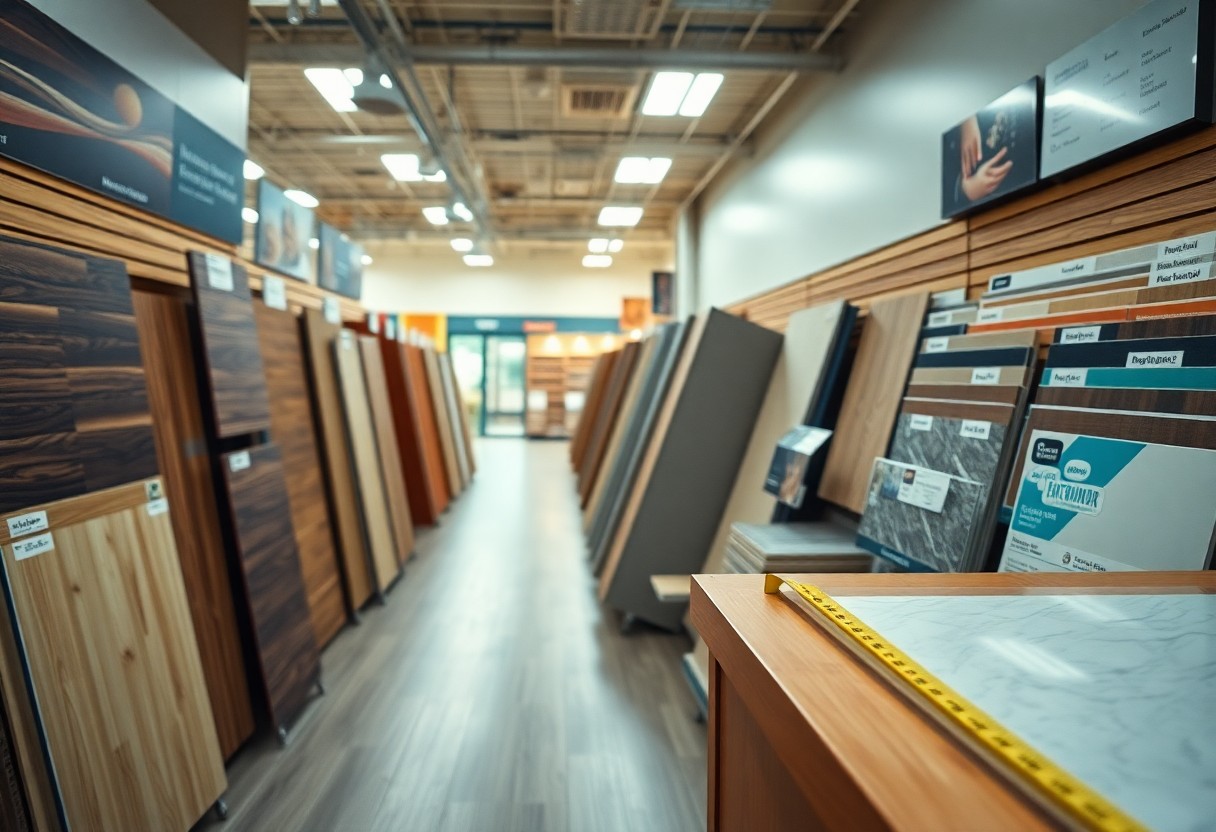
Evaluate whether samples are organized by category and clearly labeled with SKU, wear ratings (AC/PEI), and price; good showrooms display full-room vignettes and keep visible backstock or inventory counts so you know if bulk order is available. You should be able to compare 50-200 options across species, finishes, and plank widths in one visit.
Dig deeper into displays: check lighting (LED vs warm bulbs) to see true finish, inspect transition profiles and underlay options near the flooring, and search clearance bins for discontinued colours (often discounted 10-30%). Test seams and click systems on demo boards, confirm acclimation requirements (hardwood commonly 48-72 hours), and ask where excess or damaged boards are stored-real stock visibility signals reliable fulfillment and accurate delivery estimates.
Making the Final Decision
Compare three written bids side-by-side: price per sq ft, labour, removal, disposal, and warranty length. Ask about lead times – in-stock vinyl often ships in 3-5 days, engineered hardwood 10-21 days – and whether underlay, trim and site cleanup are included. Confirm who measures (store or installer), request installer credentials and photos of the last three projects, and insist on a contract with deposit (commonly 30%) and firm start and completion dates.
Trust Your Instincts
If a salesperson dodges detailed answers or rushes you, your instinct is signaling risk; choose the store where staff answer technical questions and show alternative samples. Check at least three references and online ratings – aim for consistent 4+ star reviews – and consider real examples: one homeowner avoided a 3-week special order and saved $500 by opting for an in-stock product with immediate installation.
Confirming Logistics
Before signing, get written confirmation of measurements, delivery window, installation date, parking/access needs, stair-carry fees, disposal costs, and crew size; demand a single-day contact person and clear start time and expected duration. Put deposits, payment milestones, and warranty start date into the contract so you know when obligations and protections take effect.
Also verify site prep and technical requirements: request an ASTM F2170 RH concrete moisture test and the manufacturer’s acceptable moisture limits in writing, schedule installers to arrive within the product acclimation window (typically 24-72 hours), allow a 10-15% waste factor for diagonal patterns, and confirm who supplies thresholds and handles permits. Insist on written change-order procedures and that the warranty activation date ties to final sign-off and payment.
Conclusion
Considering all points, you should prioritize clear estimates, in-person product selection, local reviews, installation warranties and showroom expertise when choosing a flooring store in Kitchener; by comparing materials, prices, and aftercare services and asking about certified installers and timelines, you ensure your project stays on budget and delivers long-lasting, attractive results tailored to your home.