
With so many flooring options, you need clear facts to choose between SPC vinyl and traditional vinyl; SPC offers a rigid, waterproof core and superior dimensional stability for busy homes, while traditional vinyl (flexible sheet or LVT) can be thinner, quieter underfoot, and often less expensive to install. Consider your subfloor condition, foot traffic, moisture exposure, and budget to determine which installation and performance profile best fits your needs.
Understanding Vinyl Flooring
You’ll compare multiple variables when choosing vinyl: durability, water resistance, installation method, and cost-per-square-foot. Traditional vinyl often runs $1-$4/ft² while luxury vinyl and SPC sit around $2-$7/ft²; wear layers range from 0.1mm to 0.7mm. You should weigh traffic levels, subfloor condition, and whether you need full waterproof performance-these concrete details determine which vinyl type suits your rooms and budget.
What is Traditional Vinyl?
You find traditional vinyl in sheet, tile, and older LVT formats made primarily from flexible PVC, usually 2-5mm thick with a printed design layer and a wear layer of 0.1-0.5mm. Installation methods include glue-down, loose-lay, or heat welding seams for sheets. You’ll see it perform well in light-to-medium traffic areas and budgets where low upfront cost and ease of cleaning matter most.
What is SPC Vinyl?
You’ll recognize SPC (Stone Plastic Composite) by its rigid, limestone-filled core-about 60-80% calcium carbonate mixed with PVC and stabilizers-giving planks 3.2-8mm thickness (commonly 4-6mm). Click-lock installation makes it a floating floor that’s fully waterproof and dimensionally stable, with wear layers typically 0.3-0.7mm, so it’s a popular choice for basements, kitchens, and commercial spaces.
You can install SPC over imperfect subfloors and many existing surfaces because its rigid core resists bowing and gaps; for example, a 5mm SPC plank with a 0.5mm (20 mil) wear layer is often specified for retail and high-traffic residential areas. Manufacturers commonly approve SPC for underfloor heating up to about 27°C (80°F), and warranties frequently extend 15-25 years depending on use, which helps you assess long-term value.
Installation Methods
When you weigh installation options, three methods dominate: glue-down, loose-lay, and click-lock floating systems; each affects labor, floor flatness tolerance, and long-term performance. Glue-down uses pressure-sensitive adhesive and is common in commercial spaces for stability and sound control. Loose-lay suits smaller rooms or short-term rentals and relies on plank weight and friction. Click-lock floating systems speed installation and reduce adhesive costs but require consistent expansion gaps-typically 1/4″ around perimeters-and a reasonably flat subfloor (about 3/16″ over 10 feet).
Traditional Vinyl Installation Techniques
For traditional vinyl you’ll encounter full‑spread glue-down sheet goods, adhesive-backed peel‑and‑stick tiles, and LVT installed with trowel-applied adhesives; sheet vinyl is often supplied in 6- or 12-foot widths to minimize seams. Heat‑welded seams are standard in wet areas-plumbing fixtures and healthcare rooms-to ensure watertight joins. Subfloor flatness recommendations commonly call for no more than 3/16″ variation over 10 feet, and professional adhesive application dramatically reduces seam telegraphing and long‑term lifting.
SPC Vinyl Installation Techniques
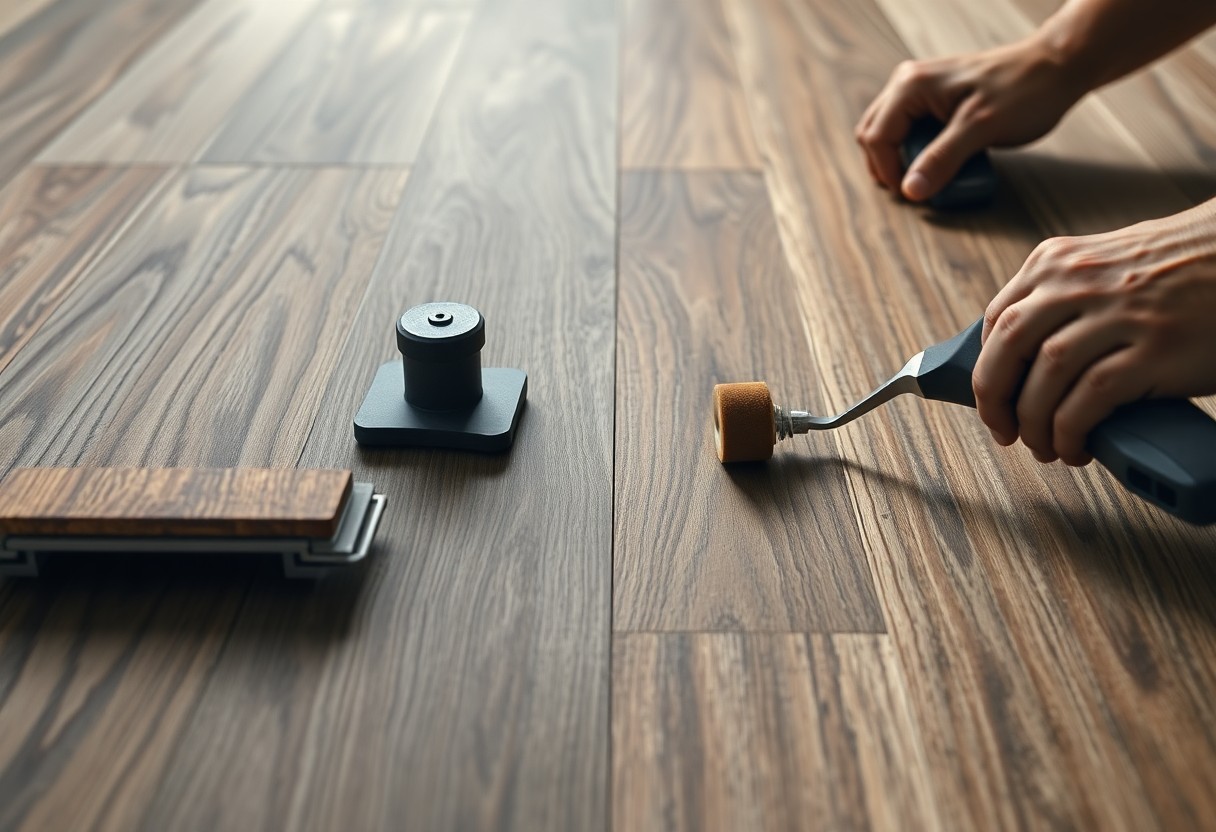
SPC vinyl most often installs as a click-lock floating floor-thanks to a rigid limestone core (typically 4-7 mm) and a 0.3-0.7 mm wear layer-so you can float it over many existing surfaces without adhesive. Some manufacturers also offer glue-down SPC for heavy commercial traffic or where a lower profile is needed. You should expect to accommodate expansion gaps (1/4″-1/2″) and consider attached underlayment options for sound reduction and minor subfloor irregularities.
You’ll want to acclimate SPC planks 24-48 hours before installation and verify substrate moisture: common adhesive and warranty limits are ≤3 lbs/1000 ft²/24 hr (ASTM F1869) or ≤75% RH (ASTM F2170) for concrete when glue-down is used. Maintain flatness around 3/16″ over 10 feet, and use a 1-2 mm foam underlayment or integrated pad to improve acoustics; an experienced crew can typically install 500-1,000 sq ft/day with click-lock systems, reducing labor costs vs. full-spread glue methods.
Durability and Maintenance
Durability affects lifespan more than initial cost, so you should weigh wear-layer thickness, core stability, and warranty when choosing. SPC’s rigid stone-plastic core typically resists indentation and temperature changes better, while traditional vinyl (LVT/LVP) can be softer under heavy point loads but still offers water resistance. You’ll see typical wear layers range from about 6-20 mil and warranties from roughly 10-30 years depending on product grade and installation method.
Comparing Durability: SPC vs. Traditional
SPC excels where you need dimensional stability and dent resistance-think kitchens, entryways, and commercial foyers-while traditional vinyl performs well in residential living areas and can match wear-layer specs if you choose higher-grade LVT. Both stand up to moisture, but SPC better resists expansion from temperature swings and heavy rolling loads; you should match wear-layer mil and warranty to your household traffic to get the lifespan you expect.
Durability Comparison
| Impact Resistance | SPC: High (rigid core); Traditional: Moderate (flexible backing). |
| Dent Resistance | SPC: Excellent for appliances/heels; Traditional: More prone to indentations. |
| Wear Layer | SPC: Commonly 12-20 mil for residential/commercial; Traditional: 6-20 mil depending on grade. |
| Water Resistance | SPC: Waterproof and dimensionally stable; Traditional: Waterproof but can expand slightly if installed improperly. |
| Typical Warranty | SPC: ~20-30 years residential; Traditional: ~10-25 years depending on wear layer and manufacturer. |
Maintenance Requirements for Both Types
You’ll keep either floor looking new by sweeping daily, vacuuming without a beater bar, and damp-mopping weekly with a pH-neutral cleaner; avoid abrasive pads and oil-based soaps. For high-traffic homes, use 18-20 mil wear layers and place mats at entries to limit grit. Clean spills within minutes to prevent staining at seams if installed loosely, and follow manufacturer guidance on steam mops and harsh chemicals to preserve the wear layer.
- Sweep or vacuum daily to remove grit and prevent surface scratching.
- Damp-mop weekly with a pH-neutral cleaner; avoid soaking the seams.
- Use felt pads on furniture and entry mats to reduce wear.
- The occasional deep clean with manufacturer-approved products every 6-12 months preserves finish and warranty.
Maintenance At-a-Glance
| Cleaning Frequency | Daily sweeping; weekly damp-mop; deep clean 6-12 months. |
| Recommended Tools | Soft-bristle broom, vacuum without beater bar, microfiber mop. |
| Cleaners to Avoid | Abraders, ammonia-based or oil soaps; steer clear of harsh solvents. |
| Spill Response | Wipe up liquids immediately; for oils, use manufacturer cleaner to avoid residue. |
| Protective Measures | Use mats, chair pads, and felt under furniture; trim pet nails regularly. |
For more practical guidance, if you have pets or rolling chairs, choose at least a 12-20 mil wear layer and use a chair mat under casters; a 2019 multi-family housing study showed floors with 20 mil wear layers lasted noticeably longer under heavy traffic. You should avoid steam mops on glued installations and replace entry mats every 2-3 years if they trap sand. Routine preventive steps cut repair needs and help warranties remain valid.
- Pick a wear layer matched to traffic: 6-12 mil for light, 12-20+ mil for heavy use.
- Install entry mats and change them every 2-3 years in sandy climates.
- Keep chair casters clean and use a mat under office chairs.
- The manufacturer’s maintenance schedule and approved cleaners will protect warranty coverage and finish longevity.
Maintenance Details for Specific Needs
| Pet Owners | Use 20 mil wear layer, trim nails, clean urine quickly to avoid odor traps. |
| High-Traffic Zones | Choose SPC or high-grade LVT with 12-20 mil and add entrance runners. |
| Rolling Furniture | Use heavy-duty casters, chair mats, and regular inspections for wear. |
| Installation Impact | Click-lock SPC tolerates subfloor imperfections; glued LVT may require more prep. |
| Long-Term Care | Follow manufacturer cleaning intervals and avoid steam mops unless certified. |
Cost Considerations
When weighing options you should separate upfront sticker price from lifetime expense: SPC typically costs more per plank but can reduce future replacement and repair bills, while traditional vinyl often has lower material cost but may need earlier replacement. For many homeowners, a 1,000 sq ft run will reveal similar total spend after factoring installation, subfloor prep, and warranties, so evaluate both immediate budget and expected lifespan before deciding.
Initial Costs of SPC and Traditional Vinyl
SPC material commonly runs $3-$7 per sq ft, with floating installation adding $1-$3 per sq ft; traditional LVT averages $2-$5 per sq ft but glue-down installs can be $2-$5 per sq ft. You should also budget $1-$4 per sq ft for subfloor prepping or moisture mitigation-SPC sometimes saves on underlayment if using a rigid core, but adhesive labor for LVT can offset lower material prices.
Long-Term Value Analysis
SPC often delivers 20-30 years of service vs. 10-20 years for traditional vinyl, so you’ll pay more upfront but replace less frequently; warranties commonly reflect that difference. Maintenance costs remain low for both-gentle cleaners and occasional resealing not needed-but factor in potential refinishing (not possible on vinyl) or earlier full replacement for cheaper LVT when calculating lifetime value.
For example, a 1,000 sq ft install at $6,000 for SPC lasting 25 years equals $240/year, whereas a $5,000 traditional vinyl replacement every 15 years equals about $333/year-excluding resale lift, water-damage risk, and disruption costs. You should include these replacement cycles, local labor rates, and room usage (high traffic or moisture areas) to determine which option is the smarter long-term investment.
Aesthetics and Design Options
You’ll see embossed, printed, and sheet styles across both SPC and traditional vinyl; plank widths typically range from 6″-9″ and sheet rolls come in 6′ or 12′ widths. Traditional vinyl favors seamless runs and broad color palettes, while SPC delivers deeper, registered embossing that matches printed grain for lifelike wood and stone. Expect wear layers commonly between 12 mil (0.3 mm) and 20 mil (0.5 mm), which strongly influence texture, gloss, and durability choices you make.
Visual Appeal of Traditional Vinyl
Traditional vinyl-sheet and LVT-gives you continuous patterns and budget-friendly visuals; sheet rolls (usually 6′ or 12′ wide) create near-seamless installations ideal for bathrooms and kitchens. LVT planks commonly measure 6-9″ wide and 36-48″ long, offering many wood and tile motifs through high-resolution printing. You’ll get broad color ranges and patterned repeats, though embossing depth is generally shallower than SPC, so tactile realism can be less pronounced.
Design Versatility of SPC Vinyl
SPC vinyl’s rigid core lets you choose wider, thicker planks-typically 4-8 mm thick with widths of 7-9″ and some collections offering extended lengths-enabling more dramatic, continuous visuals. Registered embossing, micro-bevels, and hand-scraped textures reproduce grain and stone relief accurately, while wear layers of 12-20 mil (0.3-0.5 mm) support higher-traffic finishes. You’ll find finishes from matte to semi-gloss and profiles that closely mimic hardwood installation aesthetics.
Manufacturers pair SPC with options like pre-attached IXPE or cork underlayment for sound reduction and easier floating installs, and many lines are fully waterproof so you can install them in basements, kitchens, or bathrooms. You can select micro-bevel, V-groove, or straight-edge profiles, plus painted bevels and 1:1 registered embossing that aligns texture to the printed image for near-authentic wood or stone replication-commercial-grade 20 mil wear layers are available where heavier use is expected.
Suitability for Different Environments
Match the flooring to the room’s conditions: moisture, traffic, subfloor evenness, and budget. SPC’s rigid stone-plastic core (typically 4-8 mm total thickness with 6-20 mil wear layers) excels in wet, heavy-traffic, or below-grade spaces, while flexible traditional vinyl (sheet or LVT at 2-5 mm) performs well where you want softness, warmth, and easier installation over slightly uneven substrates. For entryways, basements, kitchens, and rental units choose accordingly.
Best Applications for Traditional Vinyl
Traditional vinyl works well in living rooms, bedrooms, and budget remodels where you value comfort, quieter acoustics, and lower material costs ($1.50-$4 per sq ft). Sheet vinyl suits long, continuous runs like hospital corridors or large bathrooms because it minimizes seams, while LVT/LVP is ideal for rentals and DIY projects with glue-down or loose-lay options and tolerates modest subfloor irregularities better than rigid cores.
Ideal Settings for SPC Vinyl
SPC fits high-traffic commercial spaces, busy kitchens, mudrooms, and basements thanks to its waterproof, dent-resistant core and click-lock installation. Typical SPC floors are 4-8 mm thick with residential wear layers from 6-12 mil and commercial options at 20 mil, so they handle heavy foot traffic, rolling carts, and pets; you’ll often see SPC specified in retail, restaurant, and multifamily projects.
Installation-wise, SPC installs as a floating click floor over concrete, tile, or plywood and often eliminates the need for full tear-out. You should ensure subfloor flatness-commonly within 3/16″ over 10 ft-and leave manufacturer-recommended expansion gaps (about 1/4″). Expect installed costs around $3-$7 per sq ft and faster commercial turnarounds, which is why professionals specify SPC when durability and low maintenance justify higher upfront expense.
Conclusion
To wrap up, weigh your priorities: if you need maximum water resistance, dimensional stability, and a fast click-lock installation you can DIY, SPC vinyl is likely right for you; if you prefer a warmer feel, lower material cost, and are installing over a well-prepared subfloor-possibly with professional gluing-traditional vinyl may suit your budget and comfort needs better.