

Many homeowners find SPC vinyl offers long-lasting performance at mid-range prices, and you should expect costs influenced by plank quality, square footage, your subfloor condition, prep and labor rates; you’ll also face add-ons like trims and underlayment. To save you can compare brands, time installations during contractors’ slow seasons, choose durable mid-grade planks, and prepare the subfloor yourself to reduce labor-steps that preserve quality while cutting overall expense.
Understanding SPC Vinyl Flooring
SPC (Stone Plastic Composite) combines limestone and PVC into a dense, rigid core that resists denting and moisture; typical plank cores range 3-8 mm thick with wear layers from 0.3-0.7 mm. You’ll see planks commonly 6-9″ wide and 36-48″ long, using click-lock profiles for floating installations. Manufacturers add UV-cured or polyurethane (PUR) coatings to improve scratch and stain resistance for high-traffic areas.
What is SPC Vinyl Flooring?
SPC stands for Stone Plastic Composite and refers to a high-density core made from limestone powder, PVC, and stabilizers bonded to a printed design layer and clear wear layer. You get a rigid, waterproof plank unlike WPC’s softer core, giving better dimensional stability in humidity or with underfloor heating. Production uses extrusion and lamination to achieve consistent thickness and pattern registration.
Benefits of Choosing SPC Vinyl Flooring
SPC offers waterproof performance, strong dent and scratch resistance, and tight dimensional stability, so you can install it in kitchens, basements, or entryways without much concern for swelling. You’ll typically pay $2-$6 per sq ft for materials and $1.50-$4 per sq ft for installation, making it more affordable than engineered hardwood or tile in many cases. Fast click-lock installation also reduces downtime during renovations.
Maintenance is straightforward: you sweep and damp-mop, and a 0.5-0.7 mm wear layer commonly delivers 10-20 years of residential performance. You also benefit from tolerance to temperature swings-SPC works well over radiant heat-and installers often complete a 1,000 sq ft room in a day with two technicians, lowering labor compared with tile that requires grout curing.
Factors Influencing Installation Costs
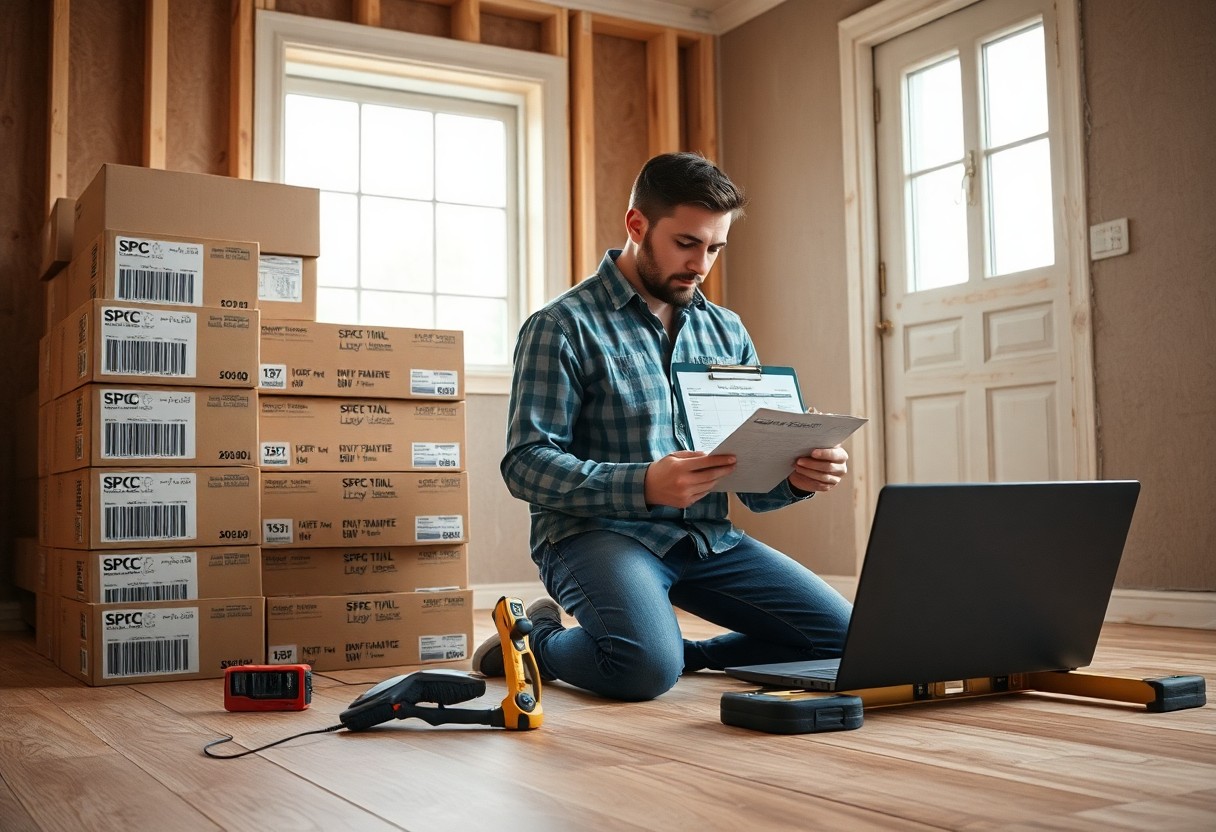
Your total comes down to several measurable items: material quality, subfloor prep, room complexity, removal of old flooring, and regional labor rates. Materials typically run about $2-$8 per sq ft depending on wear layer and thickness, while installation labor averages $2-$6 per sq ft; subfloor leveling can add $1-$4 per sq ft and trim or transitions $50-$200 per doorway. Any estimate should itemize materials, labor, and extras so you can compare bids.
- Material quality and wear layer thickness
- Subfloor condition and leveling needs
- Room size, layout, and cuts around fixtures
- Removal and disposal of existing flooring
- Stairs, thresholds, and transitional pieces
- Local labor rates and travel fees
Material Quality
You’ll pay more for thicker SPC cores (3-8 mm) and heavier wear layers (about 12-30 mil); budget SPC runs roughly $2-$4 per sq ft, mid-range $4-$7, and premium options $7-$12. Denser boards resist gouges and often reduce subfloor prep-saving you $0.50-$2 per sq ft in leveling costs-while brands with embossed textures and enhanced UV coatings typically carry longer warranties and higher upfront prices.
Labor Expenses
Your installer fees vary by experience and region: many professionals charge $2-$6 per sq ft or $30-$70 per hour, with metro areas trending higher. Complexity raises the rate-staircases, built-ins, and angled layouts add time-while straightforward single-room installs lower per-sq-ft costs; removal of old floor commonly adds $1-$2 per sq ft to labor totals.
For example, a 200 sq ft living room often takes two installers 4-6 hours; at $3 per sq ft that’s about $600 labor, plus $400 for mid-range materials equals roughly $1,000 total. Seasonal demand, permit requirements, and whether the crew brings specialized tools (moisture meters, grinders) can swing labor by 10-30%, so get itemized bids listing crew size, estimated hours, and any added prep or disposal charges.
How to Calculate Your Installation Budget
Measure your install area precisely, then multiply square footage by per‑square‑foot totals for materials and labor; for example, a 500 sq ft room with $3.50/sq ft SPC, $0.50 underlayment and $2.00 labor equals $3,000. Add contingency-typically 10-20%-for waste, cuts, and unexpected subfloor work, bringing that example to $3,300-$3,600. Factor in removal, trim, and delivery to arrive at a realistic project budget before you sign any contract.
Estimating Material Costs
SPC planks usually run $2-$6 per sq ft depending on brand and wear layer; underlayment adds $0.25-$1.00 per sq ft, while transitions, reducers and stair nosing can add $10-$60 each. You should price full cartons (add 5-10% waste for straight runs, 10-15% for diagonal patterns). For a 600 sq ft job at $3.25/plank and $0.50 underlayment expect roughly $2,100 in material costs plus trims and adhesives.
Factoring in Labor and Additional Expenses
Labor rates vary by region and complexity, commonly $1.50-$4.00 per sq ft for standard installations; removal of old flooring runs $1-$3 per sq ft, and subfloor repairs can be $200-$1,200. You should also budget for disposal fees, delivery ($50-$200), permits if required, and any appliance moving or cabinet trimming-these add up quickly on larger projects.
Installer experience affects both price and time: veteran crews may charge $2.50-$4.00/sq ft but finish faster with fewer callbacks. Stair work typically costs $30-$60 per step; complex layouts or short runs increase labor by 10-25%. Get at least three detailed quotes that break out square footage, waste allowance, removal, prep, and line‑item extras so you can compare true total costs and negotiate effectively.
Tips for Reducing Installation Costs
You can cut SPC installation costs by prepping the subfloor yourself, buying remnant or discontinued runs, and grouping rooms to reduce mobilization fees; subfloor prep typically saves $0.50-$1.50 per sq ft and end-of-line stock often drops 10-30% off material prices. Perceiving which tasks match your skill set helps you decide what to DIY and what to hire.
- Prep subfloor (saves $0.50-$1.50/sq ft)
- Buy remnant/discontinued planks (10-30% off)
- Order exact square footage + 5-7% waste
- Schedule installers during weekdays/off-season for lower labor rates
- Get 3 written quotes to leverage price
DIY Installation vs. Hiring Professionals
You save on labor by DIY-professional installation usually runs $1.50-$4.00 per sq ft, so a 300 sq ft room might cost $450-$1,200 to install; plan $100-$400 for tools and adhesives if you don’t already own them. Warranty implications, complex layouts, or moisture mitigation often make hiring pros worth an extra $300-$800 on average, particularly when they include guarantees and faster completion.
Timing Your Purchase for Savings
You can score the best material discounts during Black Friday, end-of-quarter clearances, and January-March inventory sell-offs when manufacturers and retailers mark down 10-40%; for instance, a 500 sq ft order at $3.50/sq ft with a 20% discount saves $350 on materials and may net $50-$150 more by booking off-peak labor.
Push savings further by contacting local suppliers when new collections launch (often Q3) so you’re first to catch clearance pricing of 20-35% on older SKUs. Ask installers about weekday or winter availability-labor rates commonly fall 5-15% in slow months. Combine material clearance with off-peak labor and order 5-7% extra for waste to avoid rush reorders that erase savings.
Preparing for Installation
You should clear the room, remove baseboards and doors as needed, and acclimate SPC boxes in the space for 48 hours at 60-85°F. Check subfloor flatness-industry tolerance is about 3/16″ over 10′-and run moisture tests on concrete (calcium chloride or in-situ RH) to meet manufacturer limits, often ≤3 lbs/1,000 sq ft/24 hr or RH ≤85%. Plan for trim, transitions, and at least 10% extra material for cuts and waste.
Measuring Your Space
Measure length and width of each area separately, including closets and alcoves, then multiply for square footage and add 10% waste; for example, a 12′ × 15′ room is 180 sq ft, add 10% → 198 sq ft. Check plank coverage per box (commonly 20-30 sq ft); using 25 sq ft/box you’d buy eight boxes for that room. Note odd angles and stair nosing needs when calculating totals.
Choosing the Right Underlayment
If your SPC has an attached pad you may not need extra underlayment, but when you do choose 1-3 mm foam, 2 mm cork, or rubber depending on sound reduction and subfloor. Concrete installations often require a 6-mil vapor barrier beneath the pad; ensure underlayment thickness doesn’t exceed manufacturer limits (commonly ≤3 mm) to avoid locking issues. Match underlayment to traffic levels and warranty requirements.
For more detail, test concrete moisture with a calcium chloride test or in-situ RH to confirm compatibility, and pick an underlayment rated for radiant-heat systems if applicable (many specify max surface temp ~85°F). In multi-family units, select cork or dense rubber to improve IIC/STC by several points; always verify the SPC manufacturer’s approved underlayment list to avoid voiding warranty and to ensure proper performance in high-traffic or moisture-prone areas.
Summing up
Summing up, you should expect SPC vinyl installation costs to vary with plank quality, installation method, and subfloor work; plan for material and labor as separate line items. You can lower your outlay by choosing mid-grade planks, timing purchases for sales, doing nonstructural prep yourself, and getting multiple competitive quotes-while weighing warranty and longevity when opting for DIY over professional install.